

June 11, 2026
Roots, Richmond, Virginia
From traditional menus being swapped out for QR codes to trading in spreadsheets for automated tools, the restaurant world looks a little different today than it did 20 years ago. Restaurateurs over the decades have seen evolutions of everything from technology to workers’ rights and minimum wage increases.
The generational shift reshaping the restaurant industry
As the industry changes, so do the generations of the people who power it. So how do restaurateurs' experiences and opinions vary across the generational subcultures? Do Gen Z and millennial restaurateurs have any common ground? And what happened to those fun playsets and dodgy ball pits that used to be at fast food joints?
If you know anything about MarginEdge, you know we’re a restaurant management system built for restaurant people, by restaurant people. We decided to sit down with a few of our former-restaurateurs-turned-[me]ople across different generations to hear more about their experiences, opinions and hot takes on the evolving restaurant industry.
![[Download Now]: Food Waste Calculator](https://no-cache.hubspot.com/cta/default/6423873/ac4e1e9a-7df9-4f58-b946-4bd3e60ec22f.png)
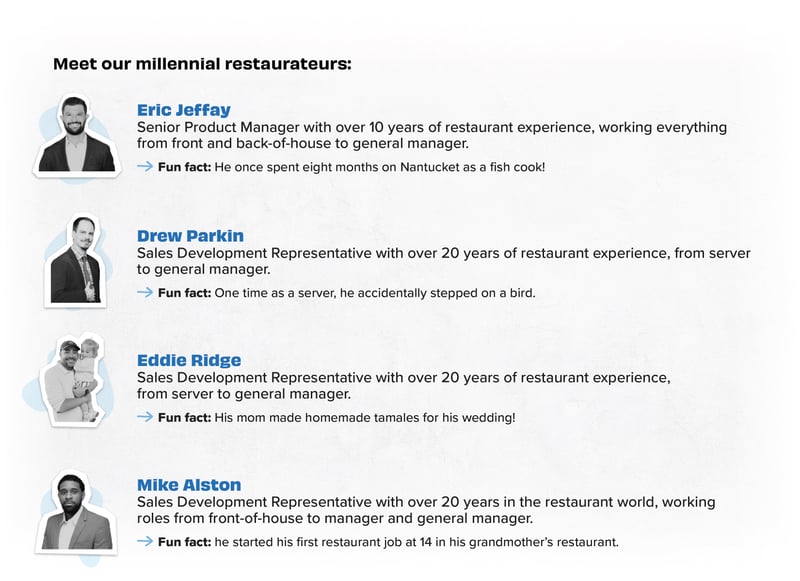
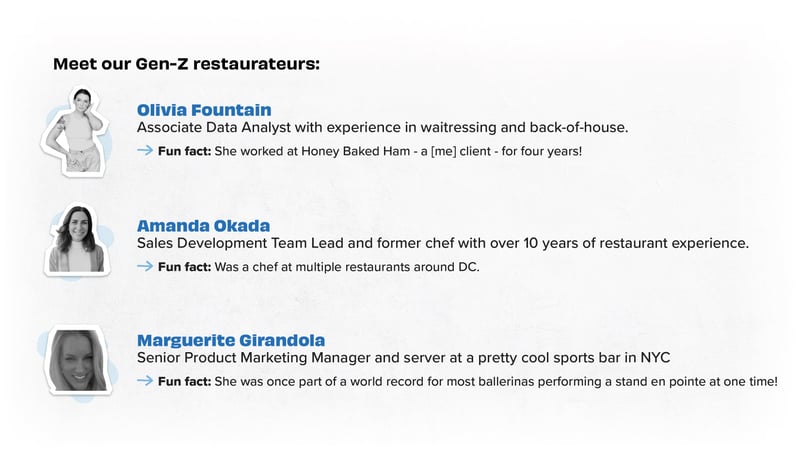
From millennials with decades of experience in managerial roles to Gen Z workers who've done everything from waitressing to back-of-house, these restaurateurs have survived pandemics, changing trends and even Mother’s Day brunch. Before we dive in, let’s meet our [me]ople.
Meet our [me]ople: Restaurateurs across the generations
Labor and scheduling: How each generation manages the floor
"What's your take on the state of labor and scheduling in the industry?
Millennial perspectives:
- Eddie - “When I was an hourly worker, labor wasn’t even really a thing. Once I became a manager, I had to think about scheduling in terms of minutes, not shifts. Let's say on a Friday night, you have eight people scheduled on the floor. Maybe last week you scheduled everybody to come in at 5:00. Can you push somebody back to 5:30? Little things like that can go a really long way. Schedule based on your sales forecast. If your target labor is 10%, but you write your schedule to 12%, you're already kind of setting yourself up not to hit your numbers.”
- Eric - “As a waiter, certain things were just beaten into my head, like you do not no-call-no-show ever. Sometimes you have to work on your birthday, or you close at midnight and come back at 8 a.m. It’s not great, but that's work, and hard work is something to be proud of.”
-
Mike - “When I was making schedules as a GM, I realized it’s easier to make cuts than it is to find somebody last-minute to come in. Always forecast how many staff you’ll need. At one place I worked for, the goal was to maintain labor costs between 17% and 18% based on a $50,000 weekly sales target. It’s easy to miss that when you don’t account for things like local events, which can leave you understaffed. For me, I’m a manager who's not afraid to work. So if I need to send someone home, I have no problem jumping in the kitchen to run expo or food, especially if I know we’re slow and need to cut numbers."
- Drew - “When I got into management and had to put bartenders’ schedules together, I did everything in my power to give them their ideal schedule. I remember as an hourly employee missing a good amount of life events - weddings, hangouts with friends and even deaths in the family - and I really wanted to give my staff a different experience. So it made my job really difficult, but it was also really fun because it was like putting a puzzle piece together.”
Gen Z perspectives:
- Amanda - “As a chef, labor was such a stress-inducer for both my staff and me. You might have to jump on the line last-minute because someone called out. It’s also challenging when you don’t want to cut labor, but because of certain pressures, you have to. At one place I worked, staff would come in thinking they’d work five days a week, but because of labor cuts, that could get reduced to three days. It made it hard for staff to be able to stay because they needed the hours. When it comes to restaurant operators, they need money to keep operating their business. When they look at what to cut, labor is the first thing, which is fair. It just sucks being the person to be like, “I'm sorry, but we can't afford you full-time. Can you work part-time?” And staff respond, "No, I have bills to pay and kids.”
- Marguerite - “As a server, my experience with scheduling at our restaurant is super chill. There are six servers, and we send our availability in a month in advance. Management assigns shifts based on that, and if extra coverage is needed, they’ll send a group text asking for help. Between the six of us, we always make it work. Everyone’s willing to pitch in if someone gets sick or can’t make it; we’re all team players.”
Wages and tipping: Where Gen Z and millennials agree (and don't)
"What's your take on minimum wage? Should gratuity be included or optional?"
Millennial perspectives:
- Drew - “As a former restaurant operator, manager, server and bartender, be generous. Leave that 20%. If they did a really great job, leave that bigger tip. But on the other hand, as a guest going into a restaurant, all those additional fees can give you a kind of sticker shock.”
- Eric - “I think there’s a complete unfairness around tips and wages when it comes to front versus back-of-house staff. The back-of-house staff is just as hardworking as the front-of-house staff, yet they get paid a wage without tips, and they don't make as much as the front-of-house. Frankly, I think they deserve more. They often go to culinary school, and they’re very talented. Also, when I was a young server in New York City, I realized the more expensive wines I could sell, the more money I would make. It became almost a competition, but it wasn’t the right thing to do. So I don't always think tipping incentivizes the right behavior from your team; if anything, it can incentivize them to upsell.”
- Eddie - “When I was waiting tables, we wouldn't receive paychecks. Our paychecks would be so small because of our wage that the taxes from the tips that we would declare would outweigh our hourly wage. I’m happy to see the minimum wage has risen a bit since then, but everything else has gone up, too, including operating costs for restaurants. I’m all for tipping accordingly, and I’m all for higher minimum wages.”
- Mike - “I believe that service staff should be compensated for their work and that gratuity should reflect the quality of the guest experience. Wages in Georgia, where I live, often start at $2.13 per hour plus tips. I prefer base wages between $5 and $7 per hour."
Gen Z perspectives:
- Olivia - “While wages and tipping in most restaurants might be based on seniority and skill level, I did see age playing a role as well. When I was in restaurants, I worked my way up over the years to key holder, and even became the youngest key holder at the restaurant. Unfortunately, I found out the other key holders were being paid more because they were older. I remember thinking, What’s up with that? What do I need to do to get a raise?’ When it comes to auto-gratuity, I think it really depends on the restaurant and service being offered. One time at an ice cream drive-through, I was charged 20% automatic gratuity at the window. In cases like that, where I’m paying more for a product than a service, I think gratuity should be optional.”
- Amanda - “When I was a chef, we just made an hourly wage with no tips, but I have been a barista before. I support automatic gratuity. I don't want to leave it up to the people who are going out to eat. I want to make sure my staff gets 20% or more every single time somebody goes out to eat. This is how we make sure everyone is taken care of.”
- Marguerite - “I feel like tipping should still be optional for the person who goes out to dine. Of course, if a server does a great job, I think you should tip 20%. I always do whenever I go out. Even if the service wasn't the best, I still tip 20%. However, I go into work every single day and never expect that in return. I personally love having my work, and the quality of my work, directly impact the money in my pocket at the end of the day.”
The restaurant industry five years from now
“What’s one thing you’d like to see change? What’s one thing you hope stays the same?”
Millennial perspectives:
- Eric - “I'd like guests to spend much more money at independent restaurants and non-corporate restaurant groups, and I'd like much of those increased profits to go to restaurant workers. In a nutshell, I think restaurant workers deserve more, but there's not much money in restaurants to give them. I'd like guests to value restaurants more, be willing to pay more and have that go to workers. I hope the people stay the same - restaurant workers are some of the hardest-working, smartest, coolest people in the world!”
- Eddie - “For change, I would like to see the restaurant industry go back to its hospitality roots. I feel like there has been a lack of ‘making people feel good’ as of recent, and that is what the industry is truly about at its core. To stay the same, just the creativity that we have seen in restaurants as of recent - whether it be the chef-driven culinary experiences or the inspired spaces - it’s something that I hope continues. When you walk into the right restaurant, it can truly transport you to another place!”
- Mike - “What I’d like to see change is the mindset of owner-operators regarding technology. I want to see a shift where tech is viewed as a necessity rather than an option. To truly retain control of your business and scale, having these systems in place is non-negotiable. I love watching entrepreneurs win, and in today's economic climate, these tools are exactly what they need to succeed. I was raised in my grandmother's restaurant, and I believe if we had the tools and knowledge that I have now, we could've scaled all over the East Coast. On the flip side, one thing I hope stays the same is the core value of hospitality and customer service. There has to be a balance between technology and the actual dining experience. Personally, I wouldn’t enjoy visiting a restaurant just to be served by robots or automated machines. I hope the industry never loses sight of the magic that comes from real human connections and great food.”
- Drew - “I'd love to see an industry-wide change to the weekly hours of full-time restaurant managers. No one should be working more than 40 hours per week. The days of 50-70-hour workweeks without overtime should be over. I do hope in five years there's still the sense of family and camaraderie in restaurant staff.”
Gen Z perspectives:
-
Olivia - “What I would change is the way we approach work and working relationships. I work best when we're able to like talk like normal human beings. Like we’re able to take off our work hats for a second and just talk. I feel some of the older generations feel that a superior and subordinate relationship needs to be rigid and structured, and Gen Z really challenges that. I would keep how intentional people are in the hospitality industry. I think it’s wonderful and a beautiful thing. Everyone should work in the hospitality industry at least once in their life because of that.”
- Amanda - “In five years, I want all restaurant folks to make a living wage and not have to work multiple jobs. It would be great if these hardworking people only had to work one job. Many of them use the money to send home to their families. A livable wage is just the right thing to do. One thing I would keep is the diversity of people who work in kitchens. That is something that makes them so special and so good. I think a lot of people go to nice Michelin-star restaurants and don’t think about who’s in the kitchen. It's going to be a Guatemalan immigrant. It's going to be super hardworking people who came to America and are trying to make money for their families. They are in every single kitchen you go to. I would definitely keep that.”
- Marguerite - “I hope in five years, roll-ups are nonexistent. I would keep everything else about the hospitality world. I love my job!”
Bonus✨: “What’s your favorite family meal?”
Millennial perspectives:
- Eric - “When I worked at Pineapple and Pearls in DC, our head chef was Chinese-American and used to make this steaming bowl of tomato, egg and rice. It was so warm and filling and good!”
- Eddie - “My mom’s tamales during Christmas time. It’s something special she’s done since we were kids, and definitely a laborious process.”
- Mike - “I worked in a predominantly Hispanic kitchen at one of my locations, and they cooked a lot: pupusas, tacos, they really brought me into the culture. That was definitely one of the best times I had with family meals. I also worked with a lot of scratch kitchen chefs, and one chef from New Orleans who would make us jambalaya and gumbo. That was definitely another favorite.”
- Drew - “My last family meal in the restaurant world was right before COVID started. There was chicken, pasta and pizza, all made in the kitchen. It was less about the food and more about the folks in the kitchen who had really become family.”
Gen Z perspectives:
- Olivia - “The ham, definitely. It was so good. I also used to work at Outback. Even though I left a while ago, everything on the menu is still so good.”
- Amanda - “When you’re a prep cook, family meal is your job. When I worked at Ris in DC, they would make Thanksgiving dinner for everybody. We would all sit down in the very nice dining room in our aprons. That place was one of my favorite restaurant experiences.”
- Marguerite - “The way it works at a sports bar, you’re usually too busy to sit down and eat, or you eat really quickly over a trash can. Our cook, Miguel, makes the best buffalo chicken wraps. And when I say buffalo chicken wrap, I really mean just a vehicle for ranch. So anything with ranch is my favorite family meal.”
The verdict: No battle, just hardworking restaurant people
Whether you’re a seasoned restaurateur or a Gen Z server just starting out, the highs and the lows of the restaurant world make it both memorable, character-building and fun. And as many of our [me]ople shared, something everyone should experience at least once. When it comes to the “battle” between the generations, there’s really no battle at all, just hardworking folks of all ages, backgrounds and lived experiences doing (and serving) their best work to the millions of people who dine out every single day. Whether you’re Gen Z, a millennial, or somewhere in between, being a restaurateur is definitely something to be proud of.
